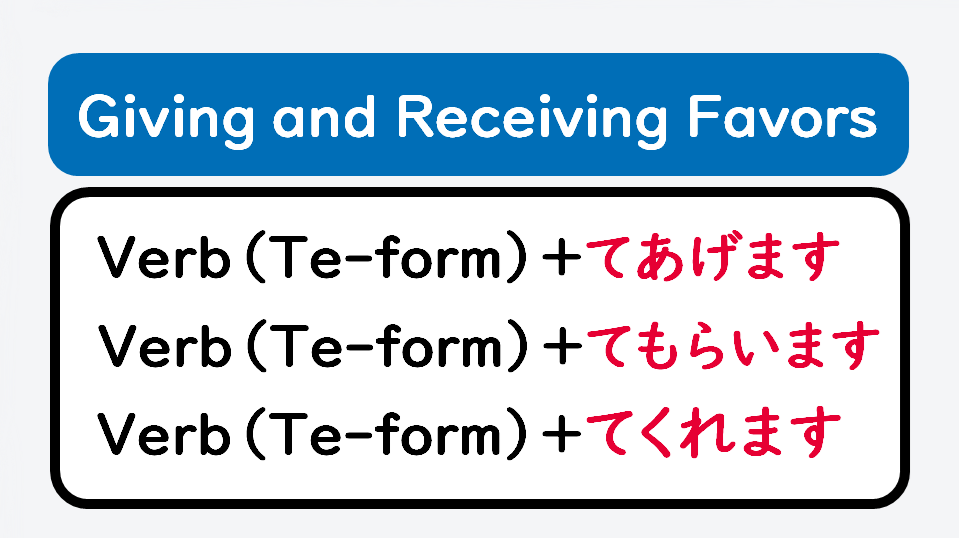
Giving and Receiving Favors:てあげます・てもらいます・てくれます
行為の授受表現(Giving and Receiving Favors)
.png)
Sentence Pattern: Verb (te-form) + てあげます
自分の行為が相手に感謝されると思うときに使います。
This expression is used when the speaker thinks that the other person will be grateful for the action.
.png)
私は学生に日本語を教えてあげました。
Teacher: I taught Japanese to the student. (The teacher thinks that the student will appreciate the action.)
Sentence Pattern: Verb (te-form) + てもらいます
相手の行為に感謝しているときに使います。
This expression is used when the speaker is grateful for the other person’s action.
.png)
私は先生に日本語を教えてもらいました。
Student: I received the teacher’s action of teaching Japanese. (The student is very grateful to the teacher.)

「てもらいます」に対応する英語文型はありません。
There is no direct English grammatical equivalent for the expression “〜てもらいます.”
Sentence Pattern: Verb (te-form) + てくれます
相手の行為に感謝しているときに使います。
This expression is used when the speaker is grateful for the other person’s action.
先生は私に日本語を教えてくれました。
Student: The teacher taught me Japanese. (The student is very grateful to the teacher.)
「てくれます」文型で行為を受け取る人は、「私」、または家族や親友など、「話し手が自分と親しい関係だと考える人」です。
In the “〜てくれます” pattern, the receiver of the action is the speaker or someone close to the speaker, such as family members or close friends.
Giving and Receiving Favors:てあげます・ていただきます・てくださいます
.png)
Sentence Pattern: Verb (te-form) + てあげます
自分の行為が相手に感謝されると思うときに使います。
This expression is used when the speaker thinks that the other person will be grateful for the action.
私は学生に日本語を教えてあげました。
Teacher: I taught Japanese to the student. (The teacher thinks that the student will appreciate the action.)
Sentence Pattern: Verb (te-form) + ていただきます
相手の行為に感謝しているときに使います。
This expression is used when the speaker is grateful for the other person’s action.
「ていただきます」は「てもらいます」の謙譲語です。
“〜ていただきます” is the humble form of “〜てもらいます.”
私は先生に日本語を教えていただきました。
Student: I received the teacher’s action of teaching Japanese. (The student is very grateful to the teacher.)
「てもらいます」に対応する英語文型はありません。
There is no direct English grammatical equivalent for the expression “〜てもらいます.”
Sentence Pattern: Verb (te-form) + てくださいます
相手の行為に感謝しているときに使います。
This expression is used when the speaker is grateful for the other person’s action.
「てくださいます」は「てくれます」の尊敬語です。
“〜てくださいます” is the honorific form of “〜てくれます.”
先生は私に日本語を教えてくださいました。
Student: The teacher taught me Japanese. (The student is very grateful to the teacher.)
「てくださいます」文型で行為を受け取る人は、「私」、または家族や親友など、「話し手が自分と親しい関係だと考える人」です。
In the “〜てくださいます” pattern, the receiver of the action is the speaker or someone close to the speaker, such as family members or close friends.
Reference: Minna no Nihongo Lesson 41
Giving and Receiving Favors:てさしあげます・てもらいます・てくれます
.png)
Sentence Pattern: Verb (te-form) + てさしあげます
自分の行為が相手に感謝されると思うときに使います。
This expression is used when the speaker thinks that the other person will be grateful for the action.
「てさしあげます」は「てあげます」の謙譲語です。
“〜てさしあげます” is the humble form of “〜てあげます.”

私は社長に傘を貸してさしあげました。
Employee: I lent an umbrella to my boss. (The employee thinks that the boss will be pleased.)
Sentence Pattern: Verb (te-form) + てもらいます
自分の行為が相手に感謝されると思うときに使います。
This expression is used when the speaker thinks that the other person will be grateful for the action.

私は社員に傘を貸してもらいました。
Boss: I received help from the employee by being lent an umbrella. (The boss is very grateful to the employee.)
「てもらいます」に対応する英語文型はありません。
There is no direct English grammatical equivalent for the expression “〜てもらいます.”
Sentence Pattern: Verb (te-form) + てくれます
自分の行為が相手に感謝されると思うときに使います。
This expression is used when the speaker thinks that the other person will be grateful for the action.
社員は私に傘を貸してくれました。
Boss: The employee lent me an umbrella. (The boss is very grateful to the employee.)
「てくれます」の文法要点については、すでに解説しておりますので、そちらをご覧ください。
The key grammatical points of “〜てくれます” have already been explained above, so please refer to the relevant section.
Reference: Minna no Nihongo Lesson 41
「てあげます・てさしあげます」の文型は、直接相手に使うと失礼になります。
特に「下→上」の関係では使わないようにしましょう。
In Japanese, expressions such as “te agemasu” and “te sashiagemasu” can sound impolite when used directly toward the listener.
In particular, they should be avoided in situations where the speaker is in a lower position than the listener, such as a junior speaking to a senior or an employee speaking to a superior.
👇下記の表現は避けましょう(Avoid the following expressions)
.png)
社長、傘を貸してさし上げます。どうぞ。
Employee: I will lend you my umbrella, sir. Here you are.

・・・・・・・・・。
Boss: …
👇下記の表現を使いましょう(Use the following expressions)
.png)
社長、傘です。どうぞ。
Here is an umbrella for you, sir. Here you are.
どうもありがとう。
Boss: Thank you.
Giving and Receiving Favors:てやります・てもらいます・てくれます
.png)
Sentence Pattern: Verb (te-form) + てやります
自分の行為が相手に感謝されると思うときに使います。
This expression is used when the speaker thinks that the other person will be grateful for the action.
「てやります」は、動物や植物、または目下の人に何かをしてあげるときに使います。
目上の人に対して使うと失礼になるため、使わないようにしましょう。
“〜てやります” is used when doing something for animals, plants, or people of lower status, such as someone younger or in a subordinate position.
It should not be used when speaking to or about someone of higher status, as it can sound impolite or disrespectful.
-300x300.png)
私は妹に英語を教えてやりました。
Brother: I taught English to my younger sister. (The brother thinks that his younger sister will appreciate the action.)
Sentence Pattern: Verb (te-form) + てもらいます
自分の行為が相手に感謝されると思うときに使います。
This expression is used when the speaker is grateful for the other person’s action.
-300x300.png)
私は兄に英語を教えてもらいました。
Sister: I received help from my brother with his English teaching. (The sister expresses her gratitude to her brother.)
「てもらいます」に対応する英語文型はありません。
There is no direct English grammatical equivalent for the expression “〜てもらいます.”
Sentence Pattern: Verb (te-form) + てくれます
自分の行為が相手に感謝されると思うときに使います。
This expression is used when the speaker is grateful for the other person’s action.
兄は私に英語を教えてくれました。
Sister: My brother taught me English. (The sister expresses her gratitude to her brother.)
「てくれます」の文法要点については、すでに解説しておりますので、そちらをご覧ください。
The key grammatical points of “〜てくれます” have already been explained above, so please refer to the relevant section.
Reference: Minna no Nihongo Lesson 41

英語-320x180.png)
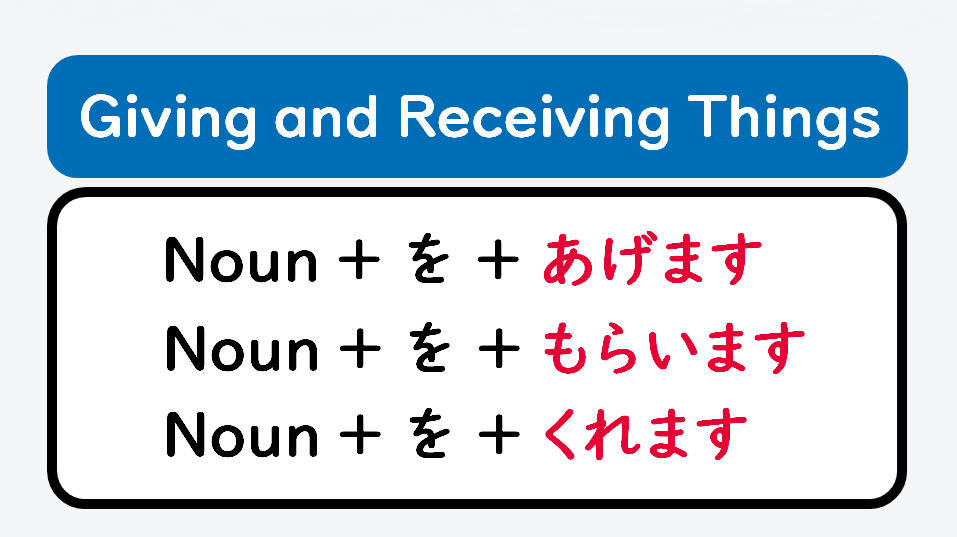
英語.png)