.png)
個人の関係(Personal Relationships):「内」の関係(Japanese In-groups)
個人の関係:「内」の関係(“Uchi: Japanese In-groups)
※敬語を使いません(Note: Honorifics are not used in close relationships)
家族、友達、恋人等(Family, Friends, Partners, etc.)
.png)
個人の関係(Personal Relationships):「外」の関係(Japanese Out-groups)
個人の関係:「外」の関係“Soto: Japanese Out-groups)
※敬語を使います(Note:Honorifics are used in distant or formal relationships)
知らない人、目上の人、親しくない人等(Strangers, Superiors, Someone you’re not close to, etc.)
.png)
| Japanese | English |
|---|---|
| すみません。ちょっとお尋ねしますが、郵便局はどちらでしょうか。 | Excuse me, may I ask where the post office is? |
| 部長、ちょっとご相談があるんですが、宜しいでしょうか。 | Manager, may I have a moment to discuss something with you? |
| お久し振りです。 | It’s been a while. / Long time no see. |
| こちらこそご無沙汰しております。 | Likewise, it’s been a while. |
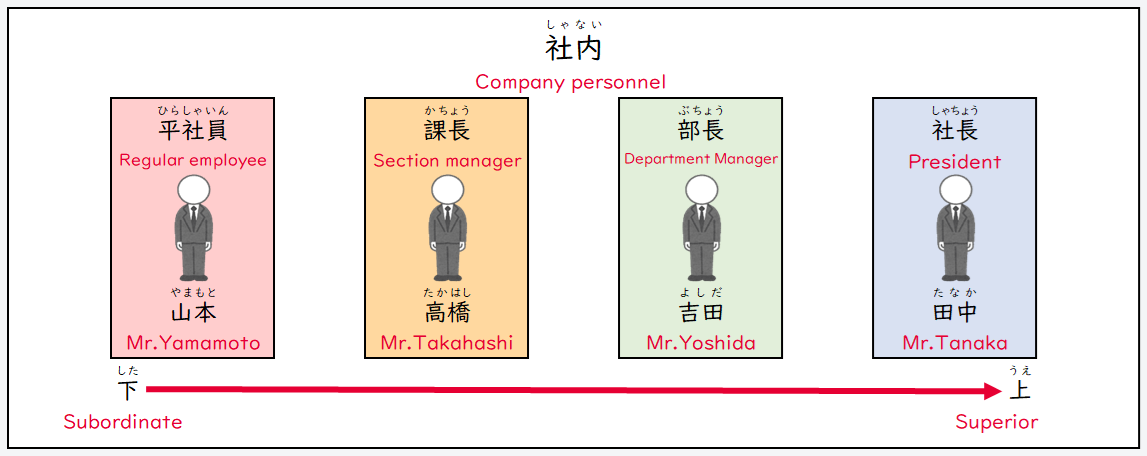
ビジネスの関係(Business Relationships):社内(Within the Company)
ビジネスの関係:社内(Within the Company: To Colleagues)
※部下から上司へ敬語を使います(Note: Subordinates use honorifics when speaking to superiors)
ビジネスの関係(Business Relationships):社外(Outside the Company)
ビジネスの関係:社外(Outside the Company: To Clients and Partners)
※取引先へ敬語を使います(Note: Honorifics are used when speaking to clients or external partners)
.png)
| Incorrect | Correct |
|---|---|
| 弊社の社長がご説明いたします | 弊社の田中がご説明いたします |
| Our president will be explaining. | Mr. Tanaka from our company will be explaining. |
| Incorrect | Correct |
|---|---|
| 弊社の部長がご説明いたします | 弊社の吉田がご説明いたします |
| Our department manager will be explaining. | Mr. Yoshida from our company will be explaining. |
| Incorrect | Correct |
|---|---|
| 弊社の課長がご説明いたします | 弊社の高橋がご説明いたします |
| Our section manager will be explaining. | Mr. Takahashi from our company will be explaining. |
| Incorrect | Correct |
|---|---|
| 私からご説明させていただきます | 私からご説明させていただきます |
| Allow me to explain. | Allow me to explain. |

「内」の人には敬語を使いませんが「外」の人には敬語を使います。
Japanese people generally do not use honorific language with people in the “Uchi” (Japanese In-groups), but they do use it with those in the “Soto” (Japanese Out-groups).
「内」と「外」は、絶対的なものではなく、状況によって変わります。
The relationship between “Uchi” (Japanese In-groups) and “Soto” (Japanese Out-groups) for Japanese people is not absolute. It changes depending on the situation.

.png)
.png)