英語.png)
Sentence Pattern: Plain Form + と言いました
Sentence Pattern: Plain Form + と言いました
Grammar Explanation: Someone said that ~

相手が話した内容を、助詞「と」の前に述べます。
Place the content of what the other person said before the particle “と”.
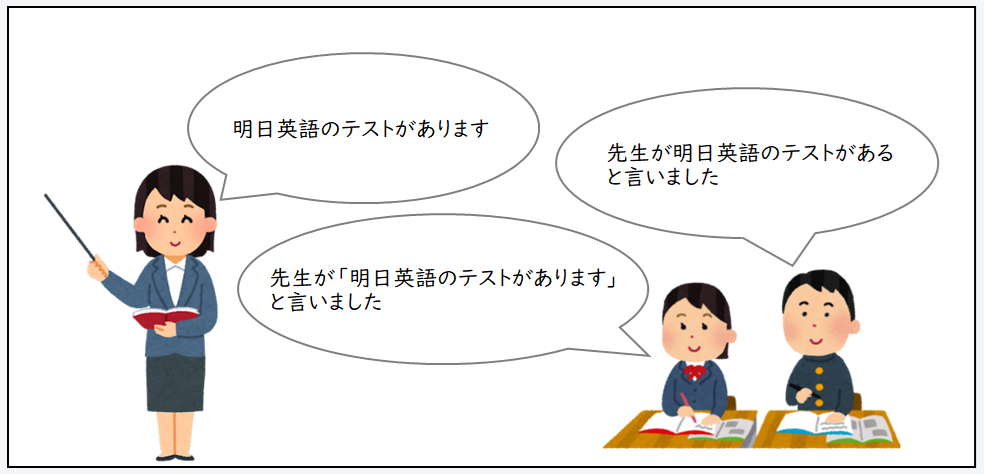
間接引用(Reported speech)
Ex.: 先生が明日英語のテストがあると言いました。
Rm.: Sensei ga ashita eigo no tesuto ga aru to iimashita.
En.: The teacher said that there would be an English test tomorrow.
直接引用(Direct speech)
Ex.: 先生が「明日英語のテストがあります」と言いました。
Rm.: Sensei ga “ashita eigo no tesuto ga arimasu” to iimashita.
En.: The teacher said, “There will be an English test tomorrow.”
Reference: Minna no Nihongo Lesson 21
Pattern: Plain Form + と言っていました
Sentence Pattern: Plain Form + と言っていました
Grammar Explanation: I heard (from someone) that ~ (Used to pass on information to others)
伝達したい内容を助詞「と」の前に述べます。
Place the content of the message before the particle “と”.
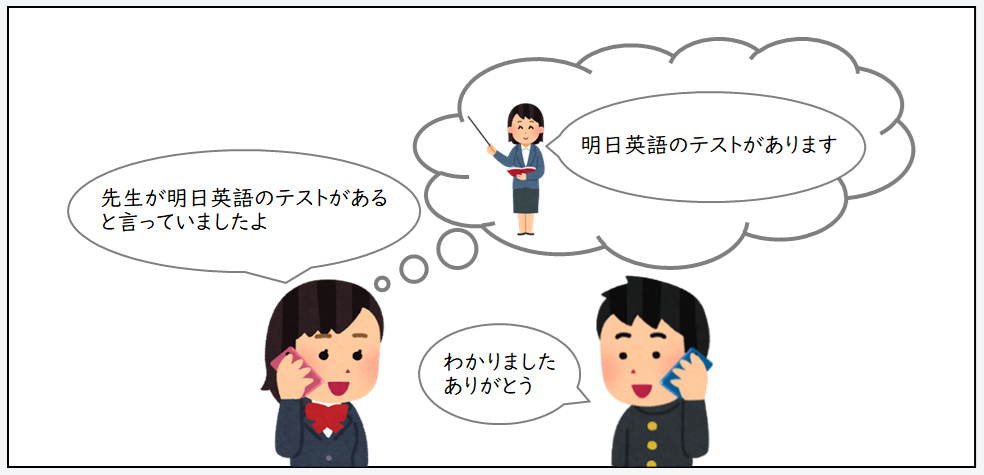
間接引用(Reported speech)
Ex.: 先生が明日英語のテストがあると言っていましたよ。
Rm.: Sensei ga ashita eigo no tesuto ga aru to itteimashita yo.
En.: I heard from the teacher that there would be an English test tomorrow.
直接引用(Direct speech)
Ex.: 先生が「明日英語のテストがあります」と言っていましたよ。
Rm.: Sensei ga “ashita eigo no tesuto ga arimasu” to itteimashita yo.
En.: I heard the teacher say, “There would be an English test tomorrow.”
Reference: Minna no Nihongo Lesson 33

英語-320x180.png)

英語.png)