英語版.png)
Sentence Pattern: Verb (Plain form) + ところです
Sentence Pattern: Verb (Plain form) + ところです
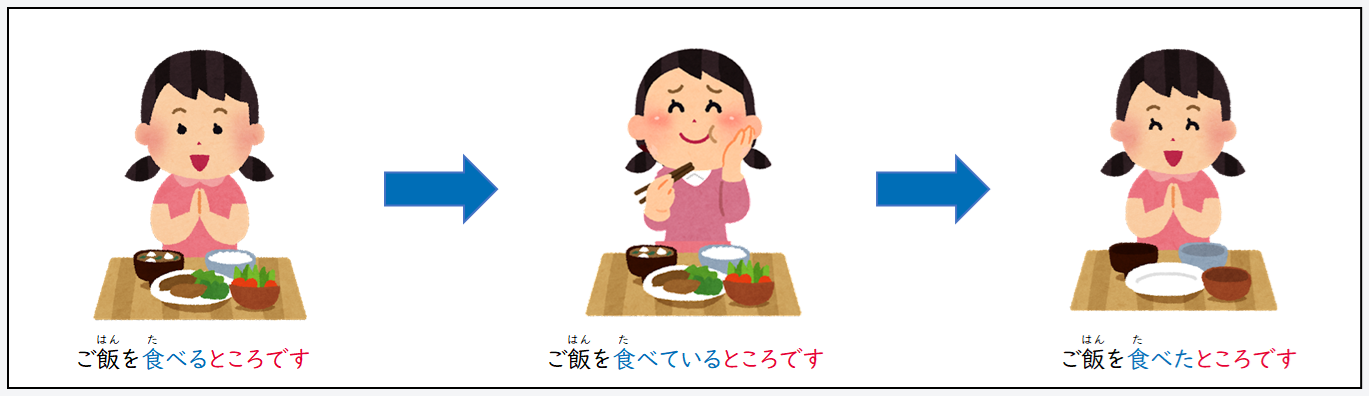
Grammar Explanation: about to do something
Ex.: ちょうど今から、ご飯を食べるところです。
Rm.: Chodo ima kara gohan o taberu tokoro desu.
En.: I’m just about to eat a meal.
Sentence Pattern: Verb (te-form) ている+ところです
Sentence Pattern: Verb (te-iru form) +ところです
Grammar Explanation: be~ing(be in the middle of doing something)
Ex.:今、ご飯を食べているところです。
Rm.: Ima gohan o tabete iru tokoro desu.
En.:I’m eating right now.
Sentence Pattern: Verb (ta-form) + ところです
Sentence Pattern: Verb (ta-form) + ところです
Grammar explanation: just finished doing something (based on time)
Ex.:たった今、ご飯を食べたところです。
Rm.: Tatta ima, gohan o tabeta tokoro desu.
En.:I’ve just finished eating a meal.
Reference: Minna no Nihongo Lesson 46
Sentence Pattern: Verb (ta-form) +ばかりです
Sentence Pattern: Verb (ta-form) + ばかりです
Grammar Explanation: just finished doing something (speaker’s subjective feeling that it was just finished)
Ex.:ご飯を食べたばかりです。
Rm.: Gohan o tabeta bakari desu.
En.:I have just eaten a meal.
Reference: Minna no Nihongo Lesson 46

「動詞た形+ばかりです」という表現は、ある動作や行為が終わった直後、または話し手がその完了からあまり時間が経っていないと感じているときに使います。実際の経過時間に関係なく、話し手が完了してから間もないと思えば使うことができ、この点が時間基準の「動詞た形+ところです」と異なります。
The expression “verb (ta-form) + ばかりです” indicates that an action or event has just been completed, or has occurred only a short time ago from the speaker’s perspective. The actual length of time is not important; as long as the speaker feels it happened “just now,” this pattern can be used. This differs from “verb (ta-form) + ところです,” which is based on timing.

| ご飯を食べたところです | ご飯を食べたばかりです |
| Just finished eating (Based on time) | Just finished eating (Subjective feeling) |

英語-320x180.png)
.png)