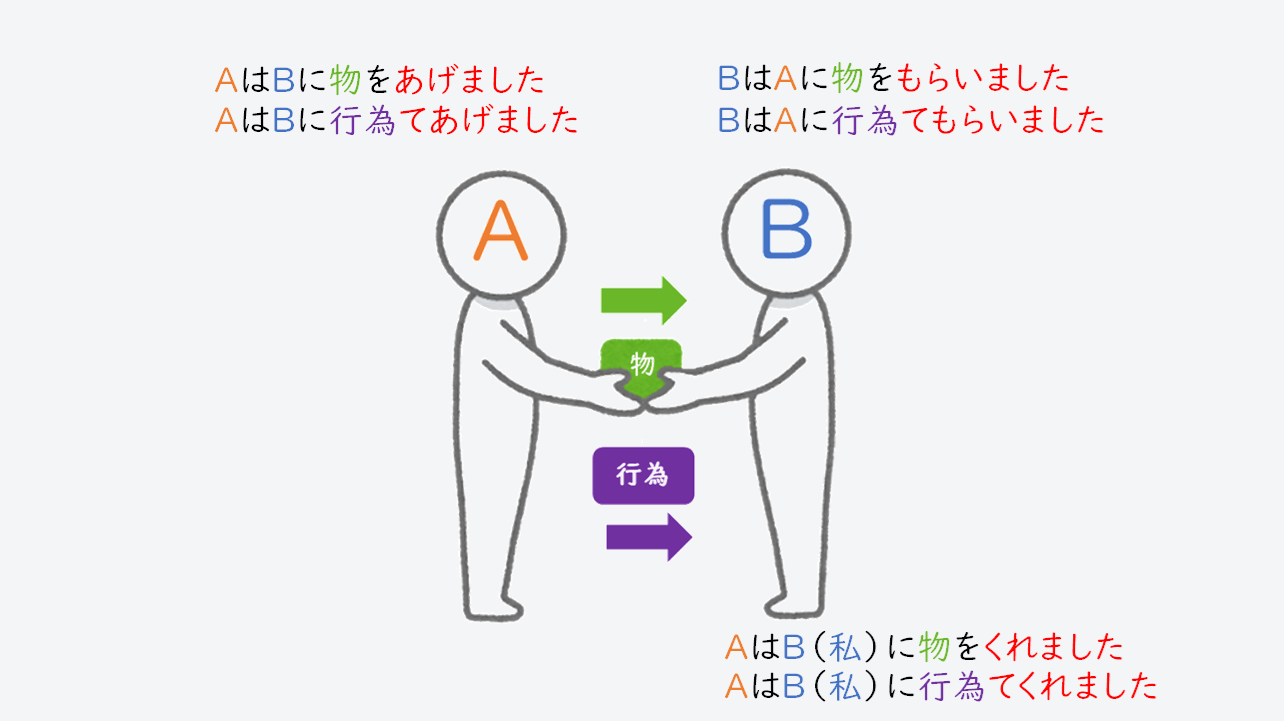
日本語の授受表現(Japanese “Giving and Receiving” Expressions)
日本語の「授受表現」は、物やサービスのやりとりをしたときに用いられる日本語独特の表現方法です。この授受表現を使うことで、特に「ありがとう」「うれしい」「満足です」などの言葉を言わなくても、相手に感謝の気持ちを伝えることができます。実際はそれほど満足していなくても、相手の好意に対する礼儀として、日本語ではよく使われる表現です。「え、それは嘘じゃないの?」と思われるかもしれませんが、日本語の背景には「相手の気持ちを思いやる」という日本の文化があるため、日本人は会話をするとき、自分の気持ちよりも相手の気持ちを優先して会話をすることが多く、相手に迷惑がかからない嘘であれば、相手が喜んでくれる話し方をしようとする気持ちが強いのです。このような日本独特の文化背景が、日本語独特の「授受表現」を生んだのかもしれませんね。
In Japanese, 「授受表現」 refers to a set of expressions used when giving or receiving goods or services between people. It is a uniquely Japanese grammatical feature. By using these expressions, speakers can convey gratitude or appreciation without explicitly saying words like “thank you,” “I’m happy,” or “I’m satisfied.” Even when the speaker may not actually feel particularly satisfied, these expressions are often used as a matter of politeness to acknowledge the other person’s kindness. You might think, “Isn’t that dishonest?” However, in Japanese culture, there is a strong emphasis on being considerate of others’ feelings. Because of this, when speaking, Japanese people often prioritize the listener’s feelings over their own. As long as it does not cause any inconvenience, there is a tendency to choose expressions that make the other person feel good. It is this cultural background that may have given rise to the uniquely Japanese system of 「授受表現」.
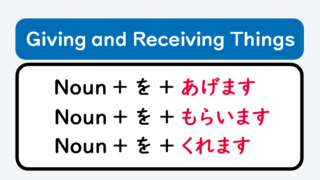
Japanese Grammar: Giving and Receiving Things
Giving and Receiving Things:あげます・もらいます・くれます
.png)

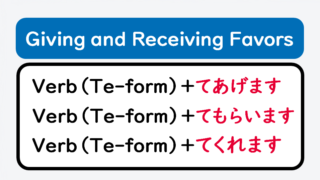
Japanese Grammar: Giving and Receiving Favors
Giving and Receiving Favors: てあげます・てもらいます・てくれます
.png)

英語-320x180.png)
.png)
.png)